

Eurotrash and Holy Water
Aleksandr Dugin combs through the ruins of history for pieces he can patch together. Vladimir Putin and Tucker Carlson are here for it.

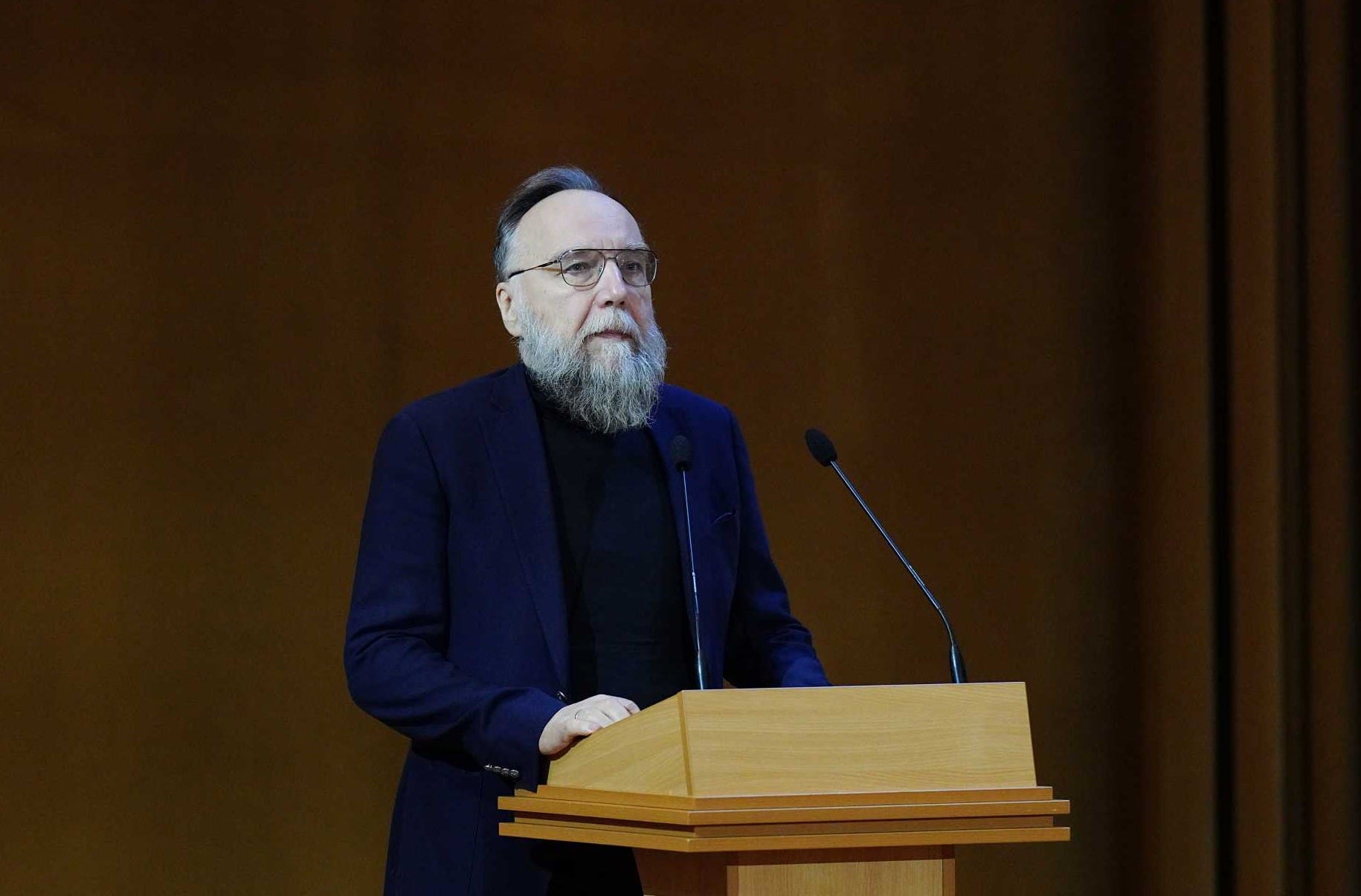
It’s called the Fourth Political Theory (4PT for short). It’s gotten the Russian philosopher Aleksandr Dugin two major fans among throngs of minor ones. The first is Vladimir Putin. The second is Tucker Carlson. Each, in his own way, is important. But together, the three make for a subversive head-heart-gut triad: Dugin the thinker, Carlson the relator, and Putin the muscle.
Much like the social justice left with its beachhead in the academy, these three are propagating their own form of ideological imperialism online. But don’t call it right-wing. Like most positions these days, 4PT defies a linear spectrum, despite the parrots of the progressive media calling him “far-right.” Instead, Dugin searches through the ruins of history to put together pieces of something new.
In what follows, I’ll react to quotations from Dugin, presented as pull quotes in italics. (I have taken the liberty of making minor readability edits to the translation.)
The Ideology
If we free socialism from its materialist, atheist, and Modernist features, and if we reject the racist and narrow nationalist aspects of the Third Way doctrines, we arrive at a completely new kind of political ideology. We call it Fourth Political Theory...
I have grown more fond of dialectical thinking in recent years, but I have also learned that dialectics, like any other tool or mode of thinking, is easily abused. So, a lot of the twentieth-century Eurotrash political philosophies have been lazy or dark applications of Hegel’s method.
Dugin’s 4PT appears to be just that—a hodgepodge of pieces he likes from the past. So, there’s little novelty in Dugin’s thought.
The 4PT explicitly positions itself as beyond the three main ideologies of modernity—liberalism (the “first,” which triumphed), communism (the “second,” which failed utterly), and fascism/national socialism (the “third,” which is just so much dark dialectics). 4PT is purportedly not so much a finished theory or closed system, but instead an open “invitation to the development of the fourth political theory, opposite communism, fascism, and liberalism,” writes Dugin.
But can it be the “opposite” of these? Or is it just a selective concatenation of at least two? It appears Dugin’s open invitation is to color within the lines he’s already drawn, with a little Russian Orthodoxy sprinkled in for good measure.
The Subject
To break free from the spell of Western European thinking, the Fourth Political Theory suggests focusing on the concept of ‘existence,’ or Dasein in philosophical terms.
Instead of the individual (liberalism), class (communism), or race/nation/state (fascism), the 4PT proposes Dasein as the fundamental subject—a category that is both phenomenological and ontological. It is also closely tied to the “people” (das Volk?) understood existentially as a cultural-historical community that includes past generations, the living, and the unborn. I guess this is how Dugin gets away with appealing to the work of the German philosopher Martin Heidegger (a Western European (Nazi) who studied under a German Jew), while claiming to break free from Western European thinking.
The people and their cultural consciousness are most decidedly tied to place and rooted in history. “In the people, previous generations, the dead, and the future, i.e., the unborn, are present,” writes Dugin. “The people become an absolute category.” Whatever forces make up the Dasein of a people is interesting as far as it goes, but it’s not clear how these forces justify the imposition of a distinct political order, whether in Russia, Richmond, or Rabat. Perhaps cultural Dasein helps to justify a right of self-determination, but that seems like too liberal a notion for the 4PT.
Again, there is little new here. One can see how America’s National Conservatism is redolent of the 4PT. Both blame liberalism for what each considers excessive pluralism, Western decadence, or the perceived subjugation of WASPs, Papists, and Orthodox Christians alike. Both NatCons and Dugin invoke premodern faith traditions and cultural conservatism to justify seizing what they imagine is their rightful place at the highest echelons of political authority.
4PT is backward looking.
Like socialism and fascism, 4PT is hostile to competing doctrines. Liberalism is, of course, the only doctrine capable of making room for various conceptions of the good, with the only caveat being that those who hold those doctrines do so peacefully and within the bounds of a coherent pluralism.
That’s why 4PT is primarily illiberal and anti-liberal, despite its supposed hostility to communism and fascism—and despite its commitment to “multipolarity.” And if one were to find any feature of liberalism in the 4PT synthesis, it must be a feature that’s preselected, integrated, and Christ-haunted. It must not stink of either the Enlightenment or entrepreneurial markets.
National Bolshevism + Pre-Modernity
Its elaboration starts from the point of intersection between different antiliberal political theories of the past... So we arrive at national-bolshevism... But that is only first step. ... We should go further and make an appeal to Tradition.
The 4PT begins at the intersection of revised anti-liberal traditions. National Bolshevism, despite 4PT being purportedly at odds with fascism, embraces its nationalism and its statism. Bolshevism is, of course, a revolutionary socialist political doctrine and movement led by Vladimir Lenin in early 20th-century Russia. Lenin adapted classical Marxism to Russia's specific political and economic conditions, ultimately laying the ideological and organizational foundation for the Soviet Union.
4PT is meant to be opposed to Marxism and fascism, yet clearly borrows from each. It goes further by drawing on pre-modern sources—tradition, theology, hierarchy, Platonic ideals, medieval society, and religious visions—while rejecting what Dugin considers the modernist flaws of prior ideologies. The Church, again, provides justification for the centralization of state power, not to mention the bureaucratic hierarchy that branches down from the authority.
Church and State reunited. But why?
Dugin believes that tradition and theology were “overthrown with the dawn of modernity.” Yet the US managed to preserve religious tradition and theology way better than Russia did.
Still, Dugin doesn’t like religious pluralism. Unlike the theological justifications for individual rights espoused by liberals such as John Locke, 4PT offers a theological justification for the state—ironically, as the Czars and the Church did (not to mention the Western European monarchies, with their ongoing religious wars and power projections).
One wonders if Dugin is motivated by an old Soviet-era enmity, and the generalized thymos of a Russian who fancies that there would have been no Soviet collapse had the Bolsheviks not discarded Russian Orthodoxy early on. If so, one can only conclude that Dugin is motivated by the indignity of loss. If only the Kremlin had baptised its Bolshevism, the socialist project might have succeeded.
The Principles
So we need to unite the Right, the Left and the world’s traditional religions in a common struggle against the common enemy. Social justice, national sovereignty and traditional values are the three main principles of the Fourth Political Theory. It is not easy to put together such a varied alliance. But we must try if we want to overcome the foe.
The foe, of course, is liberalism—and its globalist avatar, the United States. The three pillars above form the positive content, or foundation, of the 4PT.
If life under Soviet communism wasn’t a kind of dark age, 4PT will surely usher in one. This time around, hungry people in the bread lines will be encouraged to pray. And the “people” will be brought up within narrower theological constraints to put God and country over commerce and plutocratic oligarchy.
Similar to the Red-Green (Marxist-Muslim) alliance taking shape on the Western left, 4PT imagines a Red-Gold synthesis.
Against Liberal Hegemony
The Fourth Political Theory is a “Crusade” against:
Post-modernity,
The post-industrial society,
Liberal thought realized in practice,
Globalism and its logistical and technological bases.
The 4PT wages war on the current post-liberal order—postmodernity, post-industrial society, realized liberal thought, globalism, and the “society of the spectacle”—while advocating a multipolar world of diverse civilizations, each with its own values and “Logos.”
I’m reminded of the National Conservatives again, especially in their confused efforts to lump Enlightenment liberalism with progressive leftism, postmodernism, and globalism. While it can be argued that America after World War II became something of an imperial global constable—and American progressives had always been eager to erect a world government through supranational institutions like the UN—such a thing is a far cry from liberalism rightly construed. Dugin and the NatCons would do well to steelman liberalism.
Liberalism as a doctrine is compatible with multipolarity to the extent that illiberal countries are capable of reining in their expansionist ambitions. This applies to the United States as much as to China or any New Duginite Russia.
Yet international game theory is a bitch.
Authentic Politics and a Pre-Modern/Postmodern Synthesis
The Fourth Political Theory insists on the authenticity of the existence. So it is the antithesis to any kind of alienation.
To complicate matters, the 4PT emphasizes some authentic existence (vs. “alienation”) and a paradoxical synthesis borrowing postmodern tools and the critique of modernity while recovering pre-modern sacredness and myth.
Ironically, then, the 4PT conjures the most utopian aspects of Marxism, which Marx abandoned to make communism more 'scientific.' When you really break it down, the 4PT should be called the 2.5PT+ROC (Russian Orthodox Christianity). I’m simply not buying that a philosophy combining Marxism with Christo-fascism is meant to oppose political philosophies 2 and 3.
The American 4PT
I’ll pass over how much Tucker Carlson and Aleksandr Dugin sound like the Queers for Palestine when it comes to the Israel/Palestine conflict. At least we know who will pay the jizya if Russia or America is overtaken by the Islamic hordes. But it’s becoming clearer by the day that Carlson has taken enough inspiration from Dugin and the NatCons to propagate a new anti-Americanism, which, rumor has it, Carlson hopes to organize more formally.
Despite all the references to Heidegger, the 4PT could have been more easily defined as anti-Randian Objectivism—equal and opposite in its adolescence. By the day, it seems as if Tucker Carlson is trying to become the tip of the spear for a distinctly American 4PT.
But Tucker Carlson is no philosopher. He’s an intellectual sockpuppet. And if he imagines he holds onto anything close to what we might call a principle, it’s America First. But that’s just a label he wraps around military non-interventionism, which he shares with Dugin and, indeed, many liberals. The rest is imported Eurotrash socialism, thrice-dunked in holy water—plus a dangerous toleration for Islamists as both seek allies among the hijabis and jihadis.
If nothing else, Dugin claims that liberalism contributes to the idea of self-determination and multipolarity, but he thinks liberalism has been far too central on the world stage. Yet liberalism is the only doctrine that can hold people with traditionalist and communitarian sympathies together in peace, so long as their doctrines are practiced locally and in their own anti-imperial niches. Because illiberal philosophies almost put intolerance at their centers, and the best 4PT can do is put competitor doctrines outside national boundaries.
Thus, both the American and Russian versions of 4PT are a Frankenstein monster of illiberal doctrines. And even if they make a couple of good points about the problems of American Hegemony from time to time, we must not let Dugin, Carlson, and Putin infect the American Project with so many bad ideas pulled from the ruins of history.
“Dugin doesn’t like religious pluralism.” How you gonna have multipolarity then?