

Gnostic Anarchists
To move the needle, freedom's ideologues need to get out of their heads and into the world.

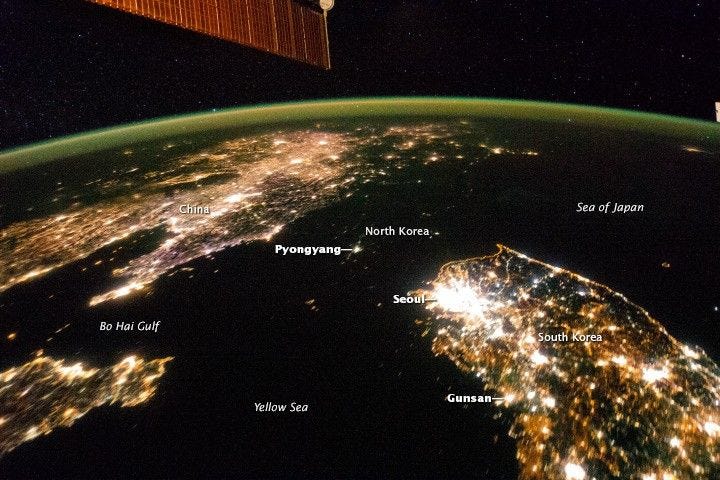
Picture two jurisdictions side by side. One is North Korea and the other is South Korea. Each has its own form of government, that is, its own set of “masters,” and its own apparatus for extracting resources and obedience. Neither is fully free. Both involve monopoly states. Yet no honest person, even an anarchist, would argue it’s wrong to prefer living in one of these jurisdictions. That is, even an anarchist would no doubt choose one side of the DMZ over the other.
The choice would not be six of one, a half-dozen of the other. Degrees of freedom matter. The kind of master matters. How much room does the master leave to live, move, trade, own property, and speak freely—even if neither jurisdiction conforms to one’s ideal?
Now we can zoom inside a single jurisdiction—say, South Korea. Here, partisans fight over who rules, which is to say they fight over who holds the monopoly on violence. Elections are a ritualized version of that fight, where ballots replace bullets. Still, I will grant a purist his premise without hesitation: elections are silly. They launder their coercive means through the language of majoritarian consent. And a vote for a master is still a vote for a master. But even silly systems like elections have consequences, and their consequences can be sillier by degree.
The democratic accountability loop is far too loose. But there is no such loop at all in North Korea.
A Shared Premise
Let me assume we’re talking to libertarian anarchists, even though those are two unfashionable terms mashed together. Also, let me stipulate just what that phrase means so we’re not talking past each other.
Anarchism, in my usage, is a condition in which no governance function falls to a monopoly. In an anarchist jurisdiction, whoever provides security, adjudication, arbitration, infrastructure, or any other governance service does so in a competitive market. The defining feature is exit. That is, a person can always contract with a rival governance provider without leaving his bedroom slippers. No provider controls the governance market by force, and competitors in such services can always enter the market.
If you can accept that as our stipulative definition of libertarian anarchism, then we agree about the goal, which we’ll call A. So disagreement is not about the goal but the means. Such disagreement sorts libertarian anarchists into two types.
The Gnostic Anarchist
We live in condition Z. The libertarian anarchists both want condition A, which is a society without a monopoly government. The gnostic anarchist looks at A, sees the vision clearly, and falls in love with what he sees. He pictures the end state in fine detail and then, in his mind, simply arrives: Z to A, with no intervening steps. Because A is the only acceptable condition to the gnostic anarchist, every other governance arrangement is equally illegitimate to him, and fighting over any of them is silly or wrong-headed. A less brutal regime and a more brutal one collapse into the same category: not-A.
The gnostic mistakes the clarity of the destination for a map. He has no path. He proposes no sequence of steps from Z to A. He offers no account of which tradeoffs move the position forward to Y and which entrench it at Z. Knowing precisely what the summit looks like, he declines any serious discussion of the climb, and treats anyone studying the slope as having compromised his principles.
The Directional Anarchist
The directional anarchist keeps the same destination in view and never loses sight of A. But he knows he is standing on real ground, and that the climb has a topography. He can’t teleport. He has to find the route: Z to Y, or perhaps to Y′, then to X, then to W, and onward, choosing each step because it opens the next.
That route involves trade-offs, and he does not pretend otherwise. Sometimes the move toward A means accepting, for now, a less oppressive ruler over a more oppressive one, because the less oppressive arrangement widens the space in which the next pathway can be built. A direct path to A is not on the board. It is not a path he nobly refuses; it is a path that does not exist. So he works within the adjacent possible, taking steps that promise a little more liberation by degree.
That’s why the Koreas example is no digression. Preferring South to North is a directional judgment in its purest form. Neither is the final destination. One is closer to the conditions under which the destination might be reached. Refusing the comparison on the grounds that both are masters is a gnostic move: technically true, but strategically empty.
Sadly, most libertarian anarchists are gnostics.
Tradeoffs with Authority ————<|>———— Parallel Pathways
I’d Like to Meet
Now, I owe the purist his strongest case because there is a version of him that deserves more respect.
A gnostic anarchist who is also a directional anarchist is a rare and uncompromising sort—one who refuses to accept tradeoffs that involve any monopoly governance function whatsoever, and who nonetheless has a strategy and tactics for getting from Z to A.
Of course, we all have to accept some tradeoffs with authorities—because that’s life in line at the DMV.
Still, perhaps his route runs through subversive innovation, through technologies that bypass the monopoly. Perhaps it runs through a startup society in some jurisdiction that no one yet controls, an experiment in building A on uncontested ground rather than wresting it from incumbents.
If there is any unclaimed territory in this world, I hope he finds it.
Indeed, if such a person exists, with an actual Z-to-A path that touches no monopoly governance function along the way, I want to meet him. I mean that without sarcasm. That person is not refusing strategy. He has found one that lets him avoid every monopoly, and we could surely learn from him.
But absent that person and that plan, we are left where we actually live: in a context that demands making tradeoffs and blazing genuine strategic pathways toward A. The discipline is not to pretend away the tradeoffs. It is to choose only the tradeoffs that open up possibilities, directionally toward A, and to refuse the ones that merely hand government authorities more power. That is the line between a directional anarchist and a court philosopher for the status quo.
The gnostic keeps his principles spotless by never setting foot on real earth. The directional anarchist gets dirt under his nails and stays on solid ground.
Only one of them is actually moving any earth.
Max, I love your attitude and vision. I don't knownwhat kind of anarchist I might be. At first I thought that a government based on Living Systems could only arise after a total collapse of our current system, which is not scalable to the planetary level. But then I began to see ways in which it might be applied here and there to at least make our governments less bad. Anyway, I do believe that I have an over-arching strategy to arrive at the goal of a truly functional way to organize our human collective at all scales, from local to planetary. I've been thinking out loud about it on my own substack. I am heartened, almost daily, by finding kindred spirits trying to find a way forward out of the mess we made of our nest.
One is reality based, the other is as lost to the real word as the most ardent socialist...and as dangerous...