

Microlooters and Macrolooters
An academic analyzes the ethics of stealing lemons while squeezing taxpayers and living off our largesse.


Jennifer Baker, PhD, receives about $100,000 per year in monetary compensation, plus an additional ~$30,000 in benefits. Because she works at a state university—The University of Charleston—supported by both state and federal taxpayers, she is the direct beneficiary of what we might call macrolooting. Her salary depends, at least in part, on compulsory taxation, placing her in the comfortable position of evaluating the ethics of breaching paywalls while leaving the coercive institutions that fund her livelihood unexamined.
Yet, as an American and resident of SC, I’m compelled to bankroll her salary and the salaries of most other academics with whom I disagree and who inculcate bad ideas in our smartest kids. In other words, if I wanted to avoid paying her salary, I would have to pay an exit tax to leave the country, and lose my citizenship.
With all this in mind, let’s turn now to the subject of “microlooting.”
Here, Baker opens a recent Psychology Today post.
If you deliberately scan one fewer lemon than you are taking at the self-checkout at Whole Foods, you might be “microlooting.” This newly coined term does a nice job of distinguishing the highly punishable crimes of shoplifting and looting from what would be going on in a “sneak an extra lemon after buying others” situation.
In this post, she considers the ethics of theft as an act of protest.
But microlooting isn’t exactly shoplifting, says Baker. She writes:
The difference is that a shoplifter might be motivated by anything at all, from need to habit to thrill. A microlooter is motivated in a distinct way: it’s [sic] fairness. You are microlooting that lemon if you think the corporation you are transacting with deserves at least a lemon less than what they are charging. It is a small (“micro”) rebellion against our commercial system and its pricing.
Fairness? I’m reminded of my five-year-old, who claims it’s not fair every time mommy or daddy says no, or gives her three pieces of candy instead of five. It’s not just that people have radically different conceptions of fairness. It’s also that people tend to rationalize whatever conception of fairness benefits them or the population they think deserves a collective pity party.
Behold, therefore, an academic who makes six figures plus benefits, probably shops at Whole Foods—but presumably neither Piggly Wiggly nor Food Lion—and would like for us to consider the ethics of activists stealing from corporations (rather than shopping with a competitor that offers lower prices).
Baker fancies she has gnostic access to a system of moral reasoning for evaluating a “rebellion” against paying prices one doesn’t want to pay.
The defining feature is not need or self-interest, but the belief that our economic system is a bit unjust and the pilfered item functions as a bit of correction. This would mean it is not experienced by the actor as low-minded but as a high-minded, symbolic protest.
High-minded? A bit of injustice? A bit of correction?
Such seems more like a bit of moral inversion that has become typical in academic bubbles. It’s easy to see why the Democratic Socialists of America are doing well. They’ve been taking classes from professors who benefit from macrolooting and so learn to justify various forms of expropriation. Now the kids are growing up to be both macrolooters and microlooters. In fairness to Baker, she buried the lede under her commentary: Microlooting is almost justifiable, but not quite.
A few commenters came out against microlooting, an idea that, unsurprisingly, stemmed from a New York Times podcast discussion. Baker thinks most reactions to microlooting are hysterical and unsophisticated, so we shall expect top-notch analysis from Baker going forward. Baker is a philosopher, after all, which means she has a deeper, more nuanced perspective than microlooting’s critics. She sums up those critics’ shallow consternation as follows:
The accusation goes: those trying to get us to soften up on takes on theft, even in the roundabout way that is done in The New York Times podcast that started off all of these reactions, are wealthy hypocrites toying with a “luxury belief” that fails to acknowledge (even) their need for staid moral categories and shared condemnation of immoral behavior.
One might caution Baker against dismissing luxury beliefs, or any other species of rational irrationality. Psychology, epistemology, and economics ought not to be simply compartmentalized or separated from ethical considerations, as they are integral to justification in ethical reasoning.
More importantly, though, what is ethical behavior if not acting on one’s acknowledgment of moral categories, even if these categories function for “ordinary people” as ethical heuristics rather than as the basis for penetrating academic analysis?
But my criticism is that these reactions to the proposed concept of “microlooting” read more like moralism than philosophy. Moralists see themselves as protecting social norms and are trying to sway others. So, they pile on as many intimidating insults (“moral turpitude”!) and fears (“moral decay”! the “social contract”!) as they can. Moralistic outrage is provocative and fun to read but at odds with the idea that we are only moral when we come to understand what we are doing by taking up big questions. [Emphasis mine.]
Like the big question of… microlooting? Seems like a clear-cut case of moral decay to me. But let’s grant Baker the idea that moral intuitions and exclamation points are not enough. At the very least, we need a coherent set of justifications for holding some belief.
So, says Baker,
Ethicists are philosophers, and in contrast, they are concerned to share the basis for their claims, not just their conclusions. Philosophy is not a rallying cry, but the examination of all sorts of behaviors that might normally pass without scrutiny.
So far, we’re pretty deep into Baker’s piece and, despite her special status as a virtue ethicist, we’ve only gotten a basic backgrounder on microlooting, some throat-clearing, and status signaling about philosophers’ superiority to pundits.
Those of us awaiting her incisive analysis do so with bated breath…
In this case, the question is: do corporations get enough feedback from us about what we expect from them? Why we pay for a lemon at a corporate checkout is a great question. And symbolic protests are not laughable. Some of our political heroes, credited with bringing down oppressive systems, have recommended symbolic protest.
So much for sharing the basis of her claims.
So far, Baker is serving up assertion without argument, you know, like the idea that “we” have “expectations” of corporations and that these are somehow basic. Why “we” ought to pay for stuff is certainly not a “great question,” at least not on its face.
First, corporations survive on feedback—from media, shareholders, and especially customers. (See more on Accountability Loops here.) By contrast, if you don’t like what Baker teaches with your money, you cannot shop elsewhere. If you don’t like Whole Foods’ lemons or lemon prices, you can buy them elsewhere. That many do not suggests Whole Foods supplies something their customers want at a price they are willing to pay. Odd that’s not enough ‘feedback’ for Baker.
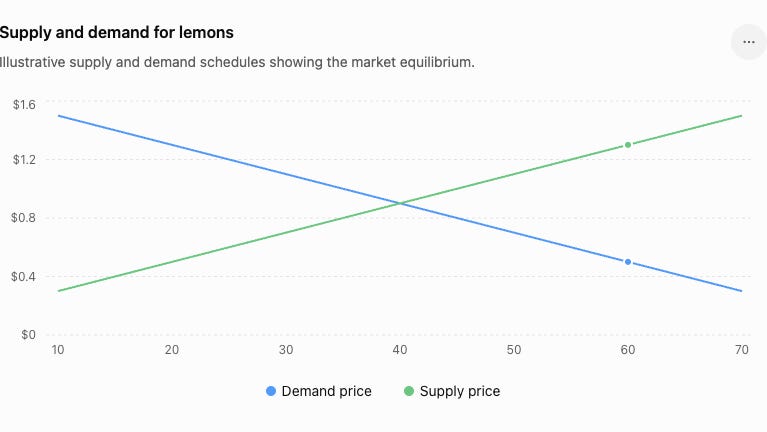
Second, a lemon is no mere symbol, but a thing people value. Prices are not arbitrary constructions but the way we determine how much certain people value certain things in conditions of scarcity. Again, prices are determined by how much people are willing to pay (or not) for a given scarce item, which might differ at Whole Foods compared to standing in line with the poor fat plebs with EBT cards at Walmart. Per economists David Prychitko and Steve Horwitz, prices are “information wrapped in an incentive.”
In this way, prices are ongoing, largely amoral experiments.
Third, value is subjective, and the value of this or that lemon is determined intersubjectively by people who are willing to pay for it and how much. So, the so-called “feedback” Baker seeks about high prices can be honestly evaluated by the number of unbought lemons Whole Foods will have to throw away or use to cook lemon-pepper chicken at the hot bar.
Bizarrely, Baker leans on the work of Vaclav Havel—the Czech anti-communist of the Velvet Revolution—to claim that protesting prices through theft might be a-okay, because we are meant to stop pretending in the face of injustice, even if our little acts of defiance make prices go up for everyone else. (Whoops, consequentialism!) I kinda doubt Havel would appreciate his work being used to justify theft by rich socialists with Platonic prices bees in their bonnets.
Up to this point, we still have little in the way of Baker’s virtue-ethics analysis, just the story of how the microlooting conversation somehow grew out of an NY Times podcast about “how to be moral in an immoral society.” We can only assume that market prices are the immoral part of society, and that microlooting might amount to practicing virtue as the people protest greedy corporations.
Finally, for something we can sink our teeth into, Baker writes:
Let me quickly illustrate how an ethicist would encourage an “ordinary person” when it comes to microlooting. She would ask, first, for microlooting to be placed into a claim about the good of symbolic protest in the face of our corporate pricing mechanisms. For example, microlooting could be considered in this form: “It would be good to get around this paywall to read news because it means I am refusing to be inattentive to how unjust it is for a society to not provide access to news.” Or maybe: “I claim some ownership of this news.”
Are we getting our money’s worth yet?
For the philosopher’s analysis, we get an imaginary quotation purporting to express what an ordinary person should think if they would just listen to the expert. But rather than offering substantive justification, even in Devil’s Advocacy, Baker immediately resorts to a false analogy. That is, she likens breaching a paywall to stealing a lemon.
Digital information, however, is much closer to a non-rival good than a lemon because the marginal cost of reproducing it is nearly zero, even if the initial cost of creating it is substantial. By contrast, producing lemons requires scarce land, trees, labor, fertilizer, transportation, and countless other inputs. Their price emerges from a long chain of production costs and market decisions far more complex than any philosopher can hope to capture in a blog post or advice to an “ordinary person.” (Despite these differences, I still don't think it is virtuous to breach a paywall. But the digression is really to make a point about economics.)
But wait, there’s more….
Baker starts to pick up on some of the economics questions, however superficially. She writes:
[T]he role news plays in a free society will need some accounting. And any initial answer will be challenged: the reporter and journalist will balk at the idea that their work is owned and explain how pay for a story supports the entire industry.
Similarly, with microlooting, the risk of prices rising for other customers will factor in. And the big question of whether our current economic policies are working and fair, and by what measures, arises.
I want to give the Devil her due, at least in part.
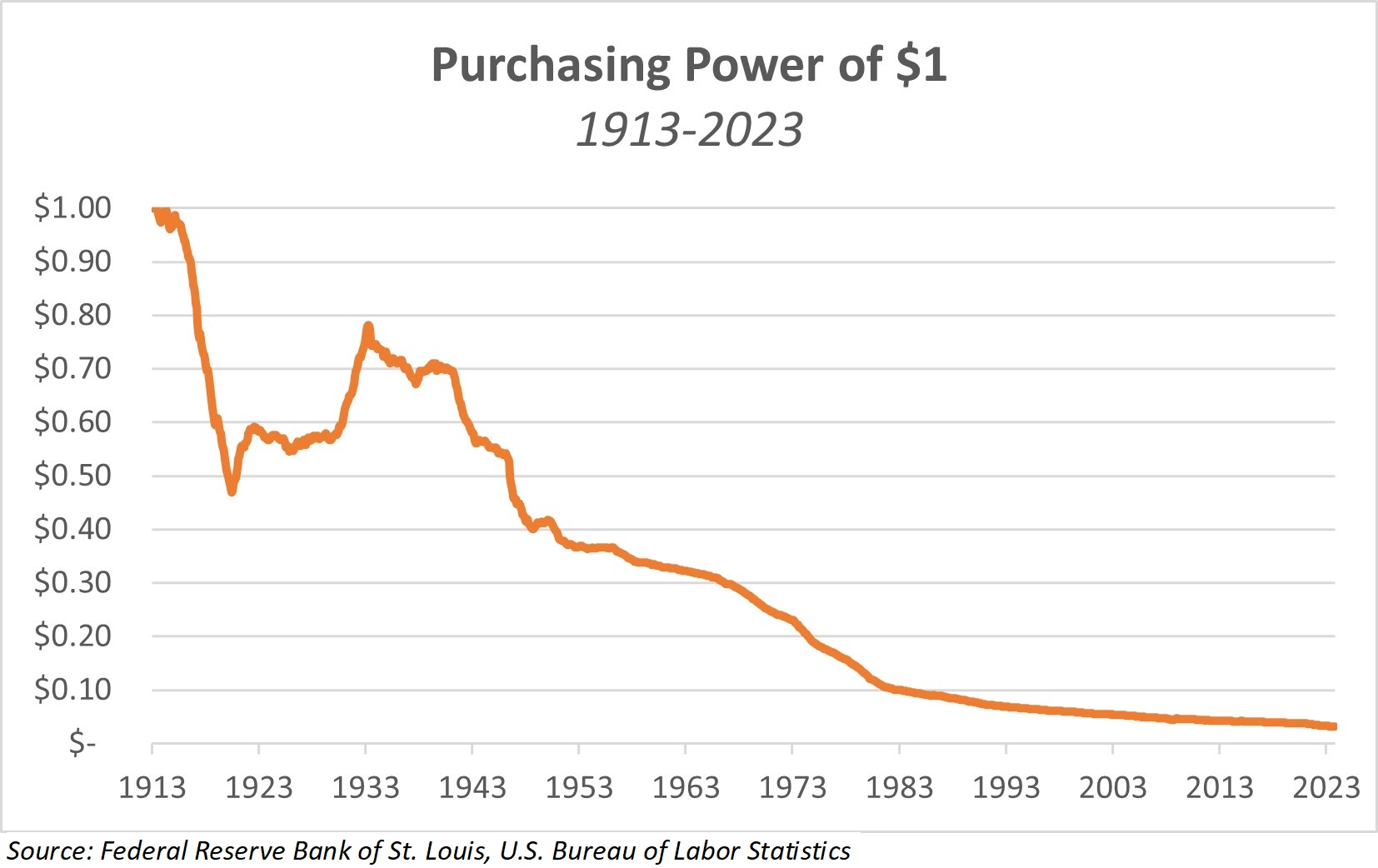
There is indeed a sense in which we can agree that our current economic policies are not working and are unfair—as measured by, say, the dollar's purchasing power over time. But I don’t think the “big question” is “whether.” The big question is why. Baker claims economists are asking “for our participation” in determining what constitutes a functioning market, a suspicious claim given most ethicists’ ignorance about economics. I dare say, before one tries to bring ethics to questions of economics and policy, she had better have a decent grasp of how markets, businesses, and different economic systems work.
For a relevant diversion, let’s look at the actual prices over five years in the US economy. Notice Baker’s own industry has the second-highest price increases behind hospitals—despite extensive macrolooting—almost double those of food.
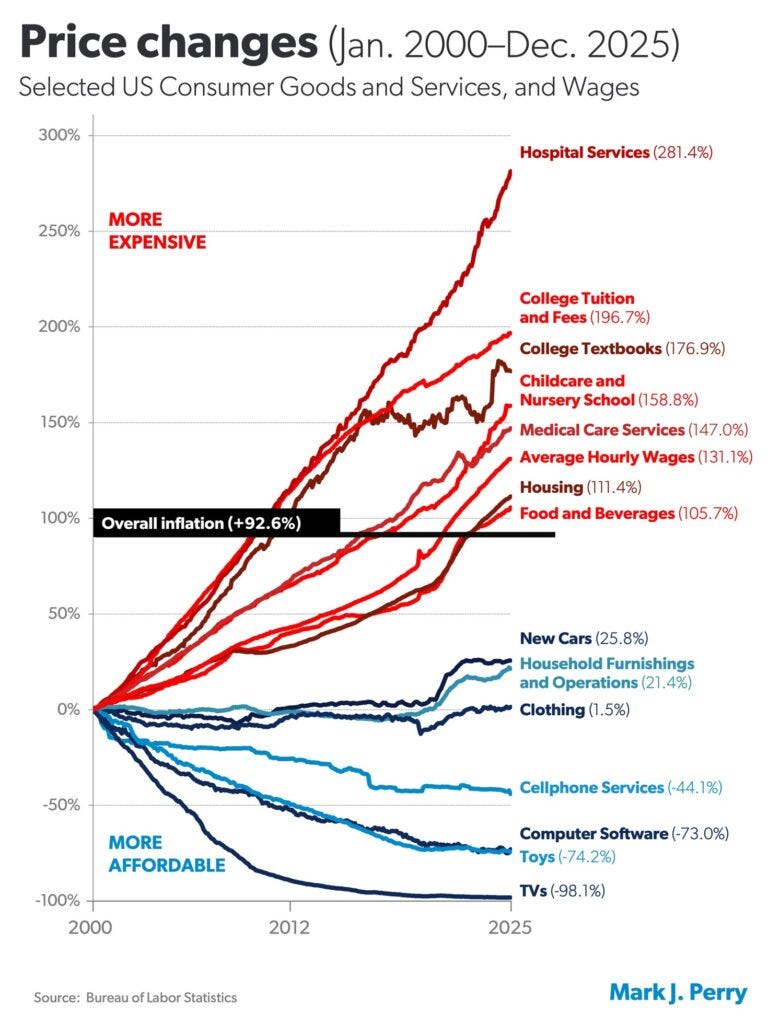
Notice also that the industries with the greatest price increases are the ones that receive the most taxpayer subsidies and government intervention. But we’re just supposed to have a generalized obsession with corporations.
Never mind these identifiable price distortions; Baker dismisses basic ethics, too, writing:
The conclusion I think a philosophical ethicist would draw, if considering microlooting, would not be based on the cumulative impact of it, as that is hard to establish with this issue.
Huh? Why wouldn’t the cumulative impact of microlooting be relevant to ethics, much like how raindrops are to floods? To argue that ethicists would not at least take the potential impact of microlooting into account would be to deny both deontological and consequentialist considerations from the jump.
With the former, we might use the Categorical Imperative to consider what the world would look like if we made microlooting a universal law. With the latter, one would consider the likely consequences of microlooting to social welfare. Baker doesn’t tell us why we should abandon two major strands of Western ethics.
Then, as if Alastair MacIntyre offers some Obi-Wan hand-wave, she turns to virtue ethics.
Where I think a person following virtue ethics would have trouble justifying microlooting is not in recognizing that our market system needs reform and that the corporations’ offering prices are not following fair or agreed-upon principles. Transacting with these corporations can very easily be something consumers regret, even while doing it.
I’ll pass over the apparent absurdity of “agreed-upon principles” of prices, a phrase dropped without explanation or philosophical bases demanded of the opinion moralists she criticizes.
First, let’s point out Baker’s emphasis on “corporations.” Corporate decisions normally account for only about 25 percent of the price of a good or service. Monetary policy by the Fed often accounts for 40 percent or more, with corporate responses and productivity serving as enablers. Energy costs are about 10-20 percent of a given price. So, despite all the speculation about what virtue ethicists might say to ordinary people, too few grasp how profligate Congressional spending leads to grotesque debt and subsequent increases in the money supply (the main source of inflation). As is typical—and woefully short-sighted—Baker paints a target on business when broader monetary and energy policies are significant drivers—especially in the grocery industry.
Baker goes on to say that someone might worry that “microlooting is done in a surreptitious way.” That feels icky, as it should. But, a “virtue ethicist would suggest we should be a little braver, a little louder, a little more investigatory and active, than just taking that extra lemon.” Perhaps, but this seems like a just-so story, especially given that her archetypal virtue-ethicist ain’t bitching about the money-supply increases designed to pay for Green New Boondoggles, COVID slush funds, stimmie checks, or non-citizen EBT cards. There is no virtue in ignorance, especially ignorance that’s a “little louder” than lemon theft. Still, we can agree with Baker that “we” should be “a little more investigatory.” (Emphasis mine.)
In what follows, notice the weasel word “seems.”
What type of behavior is appropriate in reaction to a pricing system that seems unfair? That is what a virtue ethicist would recommend, not just what feels brave and rebellious, but what actually is. If we do not have the means to figure that out together, we “ordinary people,” then virtue ethics suggests that no one else does, either. [Emphasis mine.]
So lemme get this straight: The big question is not whether a small act of defiance feels satisfying, but whether it is truly virtuous. After all, according to Baker, virtue ethics calls us to seek the courageous, public, and principled response to injustice—not merely a petty, secretive one.
That’s it? The buried lede is: Be a more courageous activist against Whole Foods prices?
Very well. I would like ordinary people to join me in speaking out courageously, openly, and publicly about macrolooting. It is neither virtuous to take one’s salary from state proxies nor to inculcate young people into becoming DSA voters because one couldn’t be bothered to understand the basic dynamics of a market economy. Yet NY Times’ podcasters and serious academics are having nuanced conversations about “big questions” like champagne socialists stealing lemons.
I’m sure Jennifer Baker, PhD, is a very nice person. But she’s part of an enormous syndicate of macrolooters. In exchange for siphoning off a percentage of my income and yours to subsidize her life in Charleston, she is willing to look away from the vice of macrolooting. Or, as likely, she has some virtue-ethics sophistry to defend her access to the public trough. She almost certainly stands up in front of students who—despite all the higher-ed subsidies—have gone into significant student loan debt, presumably to tell them they shouldn’t surreptitiously steal lemons, but instead be “louder” and more “active” in standing up against companies and their pricing decisions.
Corporations’ contribution to the price of lemons is negligible compared to the shameful profligacy of Congress and the money printing by the Federal Reserve. Notice that on a typical $100 grocery bill in the United States, the average supermarket keeps only about $1.70 to $2.10 as net profit. The remaining $97.90 to $98.30 is consumed by the costs of running the business, including purchasing food from suppliers, paying employee wages and benefits, covering rent and utilities, maintaining refrigeration and equipment, transporting goods, absorbing losses from spoilage and theft, paying taxes and interest, and meeting countless other operating expenses. Grocery retailing is therefore a high-volume, low-margin business in which even small increases in costs can significantly affect sales.
Most “ordinary people” don’t get that US debt stands at 130 percent of GDP, that the Federal Reserve prints money to service that debt—debt service that is now larger than the entire defense budget—and that this is the main driver of higher prices. If neither ordinary people nor virtue ethicists understand the grocery business, much less the economy, we have to start asking more serious questions about macrolooting by professors, pundits, and politicians.
Blecch. The hideous Ms. Baker is rationalizing theft, pure and simple. She's encouraging a Victim attitude toward the world, a sure way to guarantee a life both unproductive and unhappy. Thanks for calling her out.
I don't "microloot" as described (or engage in any other shoplifting or theft activity).
However, if offered the option of self-checkout or a cashier, I choose the latter. My wife disagrees with me and prefers self-checkout. My position on the issue is that I'll be glad to ring up and pay for my groceries or whatever once the seller offers to pay me (presumably in the form of a discount) for that work.
If a store offers only self-checkout, its owners should recognize that, well, mistakes will be made. Was that one lemon not scanned because the customer was "microlooting," or because the customer was thinking about the baseball game last night and fumbled the work? I suspect that in many cases it can be hard to tell for sure, and in such cases the most the seller should really be able to do is step in, correct the error, and fire the customer.